HelpMeFind Roses, Clematis and Peonies
Roses, Clematis and Peonies
and everything gardening related.
 Description  Photos  Lineage  Awards  References  Member
Ratings 
 Member
Comments 
 Member
Journals 
 Cuttings  Gardens  Buy
 From 
 
'Seven Sisters' rose Description
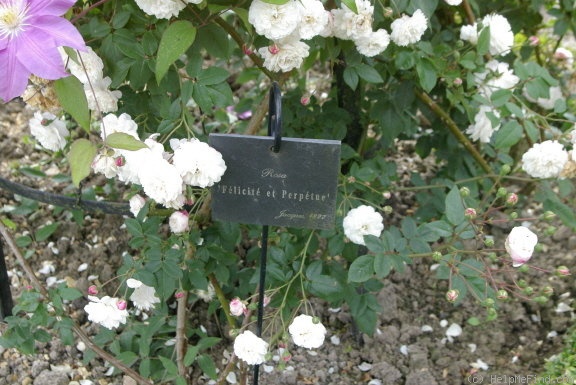
'Félicité et Perpétue' rose photo
Photo courtesy of Beatrice Lukas
Availability:
Commercially available
Synonyms:
Félicité et Perpétue
Félicité Perpétue
Lilly Ito

Also referenced as:  Félicité Perpétuelle,  Noisette florabunda,  Noisette compacta,  Mademoiselle Euphrasie,  Abelard Sempervirens
HMF Ratings:
6 favorite votes.  
EXCELLENT- overall member rating.  
ARS:
White, near white or white blend Hybrid Sempervirens.
Registration name: Félicité et Perpétue
Origin:
Bred by Antoine A. Jacques (France, 1827).
Class:
Hybrid Sempervirens, Rambler.  
Bloom:
Light pink to white.  Mild fragrance.  up to 40 petals.  Average diameter 1.5".  Small, full (26-40 petals), cupped-to-flat, globular bloom form.  Once-blooming spring or summer.  
Habit:
Climbing.  Small foliage.  5 to 7 leaflets.  
Height of 15' to 20' (455 to 610 cm).  Width of 10' to 12' (305 to 365 cm).
Growing:
USDA zone 6b through 10b.  Shade tolerant.  Requires spring freeze protection (see glossary - Spring freeze protection) .  Can be grown in the ground or in a container (container requires winter protection).  
Notes:
Parentage unsure, see References.
One of the Roses that "passed the test" in Longwood Garden's Ten-Year Rose Trials. [From A Year of Roses, by Stephen Scanniello, pp. 146-147:] Tree roses, also called standard roses, are often displayed to their best advantage when planted in containers... Tree roses come in heights anywhere from two feet high (most common with miniature roses) to over six feet. There are two forms of standard roses available. One if the common form of a long stem supporting a bushy display of roses, sort of like a large lollipop. The other is a weeping standard, the only style I think worth using.


Tree roses are created by attaching three buds of a rose cultivar to a long straight stem of another rose. The most common stem stock to use is an unnamed rugosa rose variety. Other roses have been used for creating standards, but the rugosa seems to be the strongest, surviving the longest.

 
© 2010 HelpMeFind.com